
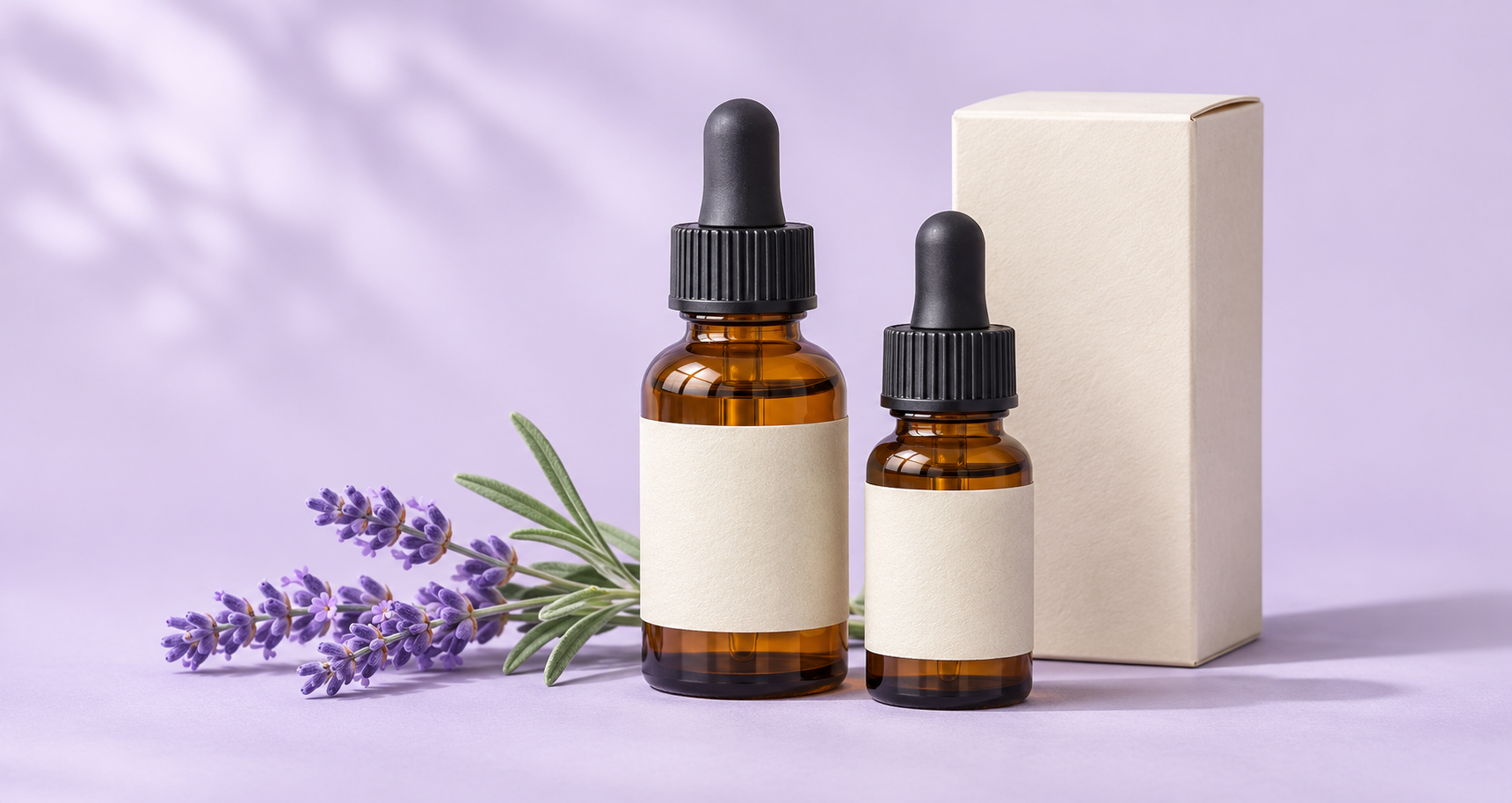
Two bottles can both say "lavender" on the front. One may contain an essential oil, while the other is a ready-made blend with jojoba oil. To understand what you are buying, turn the bottle over and read the ingredients. If the small label has too little space, check the box and the manufacturer's product page.
Five label details to check
- Product name and type. The packaging may describe a single essential oil, a blend of essential oils or a product mixed with a carrier oil. The word "lavender" on the front does not tell you which it is.
- Botanical name or ingredients. For a single oil, look for the plant's name. For example, Lavandula angustifolia is the scientific name of English lavender. For a blend or a ready-made product, read the full ingredient list, including any carrier oil.
- Plant part and extraction method. Check which part of the plant was used. It could be leaves, peel or flowering tops. The extraction method is a separate detail. For example, a label might say "Extraction method: steam distillation".
- Manufacturer or supplier. Look for the company's name and a way to contact it. If the packaging and the product page disagree, ask the seller for a photograph of the packaging on the item they will send.
- Batch number. Look for a code beside LOT or Batch. If the seller sends a document about the batch, compare its code with the bottle or box.
The eoASSIST oil reference
Search for oils by name and open their reference entries.

Comparing two labels that say "lavender"
The examples below are fictional. They show which details to read together.
| Label detail | Bottle A | Bottle B |
|---|---|---|
| Front label | Lavender. Essential oil | Lavender. Ready-made blend |
| Ingredients | English lavender essential oil (Lavandula angustifolia) | Jojoba oil, lavender essential oil |
| Plant part and extraction | Flowering tops. Steam distillation | Not stated on this example label |
| Batch code | LOT L-014 | LOT M-021 |
Bottle A lists one ingredient and identifies the plant species. Bottle B lists jojoba oil but does not specify the lavender species. If the species matters for your purchase, ask the seller to clarify it for Bottle B. These labels alone do not establish which product is higher quality.
What to ask when information is missing
Name the product and the missing detail. For example: "Please send a photograph of the back of the packaging. Which lavender species is listed in the ingredients, and does the product contain a carrier oil?" If you are offered a batch report, ask where its batch code appears on the packaging.
To look up a name, open the eoASSIST oil catalogue and search for the name you read on the bottle. Check the ingredients of the actual product against its packaging or the manufacturer's description.
Sources
- AHPA guidance on labeling undiluted essential oils. Industry association guidance, 2023 edition.
- IFA guidance on purchasing oils and reading labels. Only the labeling section is used here.
- Kew, Plants of the World Online: Lavandula angustifolia. Source for the scientific name in the example.
The eoASSIST oil reference
Search for oils by name and open their reference entries.