
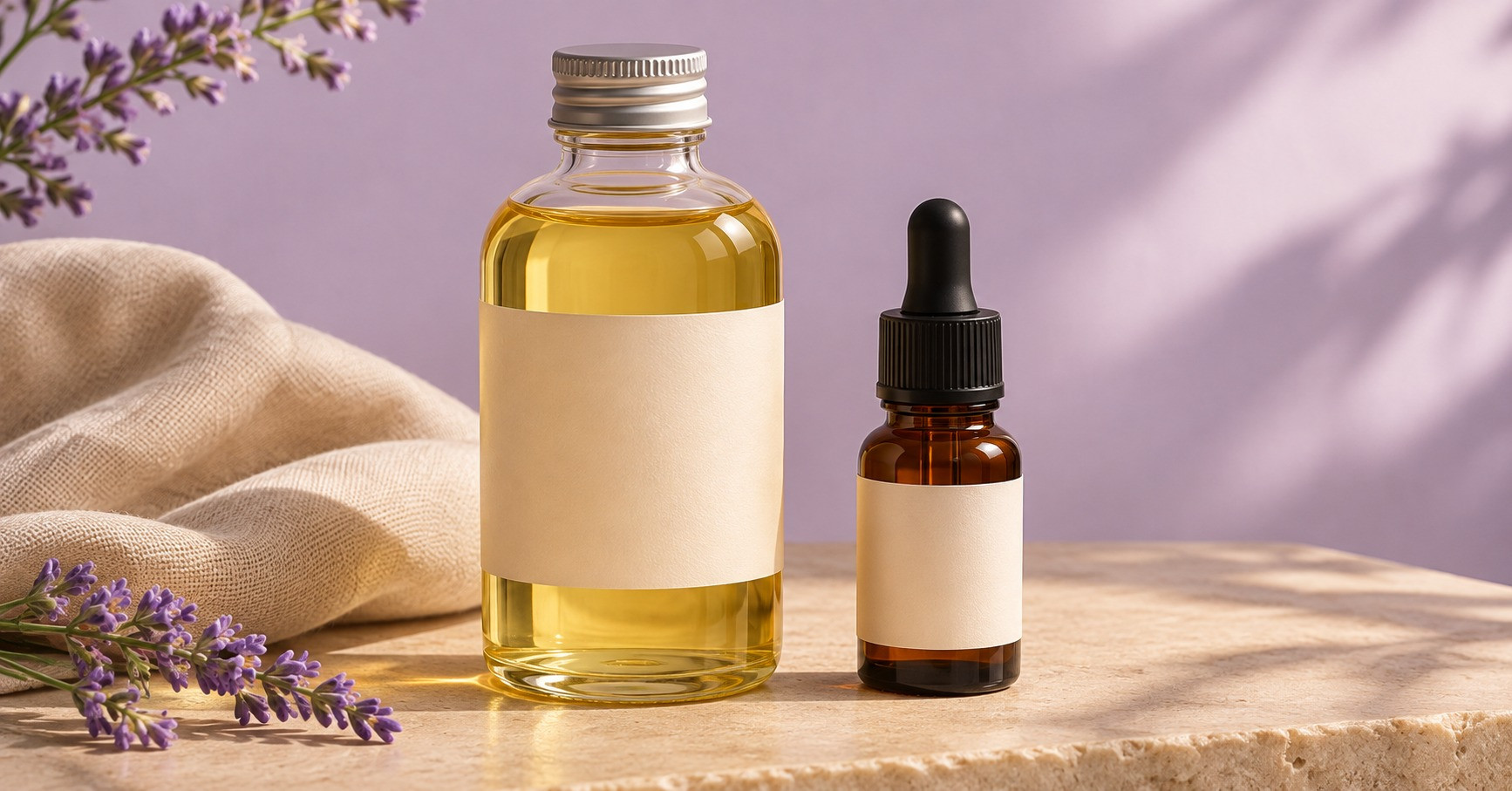
A carrier oil and an essential oil can sit on the same shelf while having different compositions. A fatty vegetable oil, such as sunflower oil, consists mainly of non-volatile lipid components. An essential oil contains mainly volatile aromatic plant components. The term "carrier" also describes the role of a base in a finished formulation.
How the compositions differ
Start with two details in the product description: its type and full ingredients. Keep these alongside the manufacturer's name. You can return to the original description when comparing another bottle or asking the seller a question.
When reading packaging, first identify the product category. Are you buying a base, one essential oil or a finished formula containing both? If the seller calls the item only "lavender oil", ask for the full ingredient information.
The eoASSIST oil reference
Search for oils by name and open their reference entries.

Read the name of the actual carrier
Product descriptions may use carrier oil, base oil or blending oil. Look for the name of the base itself and its ingredients. A description of its role should not take the place of information about what is in the bottle.
For a finished product, read the whole list. If it includes a carrier and lavender essential oil, it is a formulation with a base. The word "lavender" on the front does not make it a single undiluted essential oil.
Three fictional label examples
These descriptions are made-up examples for comparison. They illustrate reading ingredients, rather than making a blend.
| Package description | What to investigate |
|---|---|
| Sunflower oil. Base oil | The name of the carrier and any other ingredients in the product |
| Lavender essential oil | The stated plant species, plant part and extraction method |
| Sunflower oil, lavender essential oil | The finished formula's ingredients and intended use |
The first two products are different categories. The third combines components in a finished formula. This table does not establish a mixing ratio, application method or device compatibility.
What appearance cannot establish
Bottle colour, package size and scent intensity do not replace the ingredients. Do not use a home stain test as proof of authenticity or quality. Check the manufacturer's information and documents that relate to the particular product.
For an essential oil, record the botanical name, plant part and extraction method. If a carrier is included, keep its name too. Use the five label checks to work through those details.
Check the finished product's use and storage directions
The presence of a carrier does not by itself establish how to use a product or how long to store it. A finished formulation has its own label and instructions. Do not replace them with directions for one ingredient.
For an electric diffuser, use the manual for the exact model. A finished product with a carrier and a single essential oil are not automatically interchangeable. Give the manufacturer the device name and the bottle's full ingredients if information is missing.
Explore essential-oil names in the eoASSIST catalogue. Use the packaging to check the contents of your actual bottle. This article does not provide mixing ratios, doses or application instructions.
Sources
- Tisserand Institute's extraction guide, Vegetable oils section. Used for the distinction between fatty vegetable and essential oils, without recipes or treatment recommendations.
- IFA labeling guidance. Used for naming the carrier in a finished formulation.
The eoASSIST oil reference
Search for oils by name and open their reference entries.