
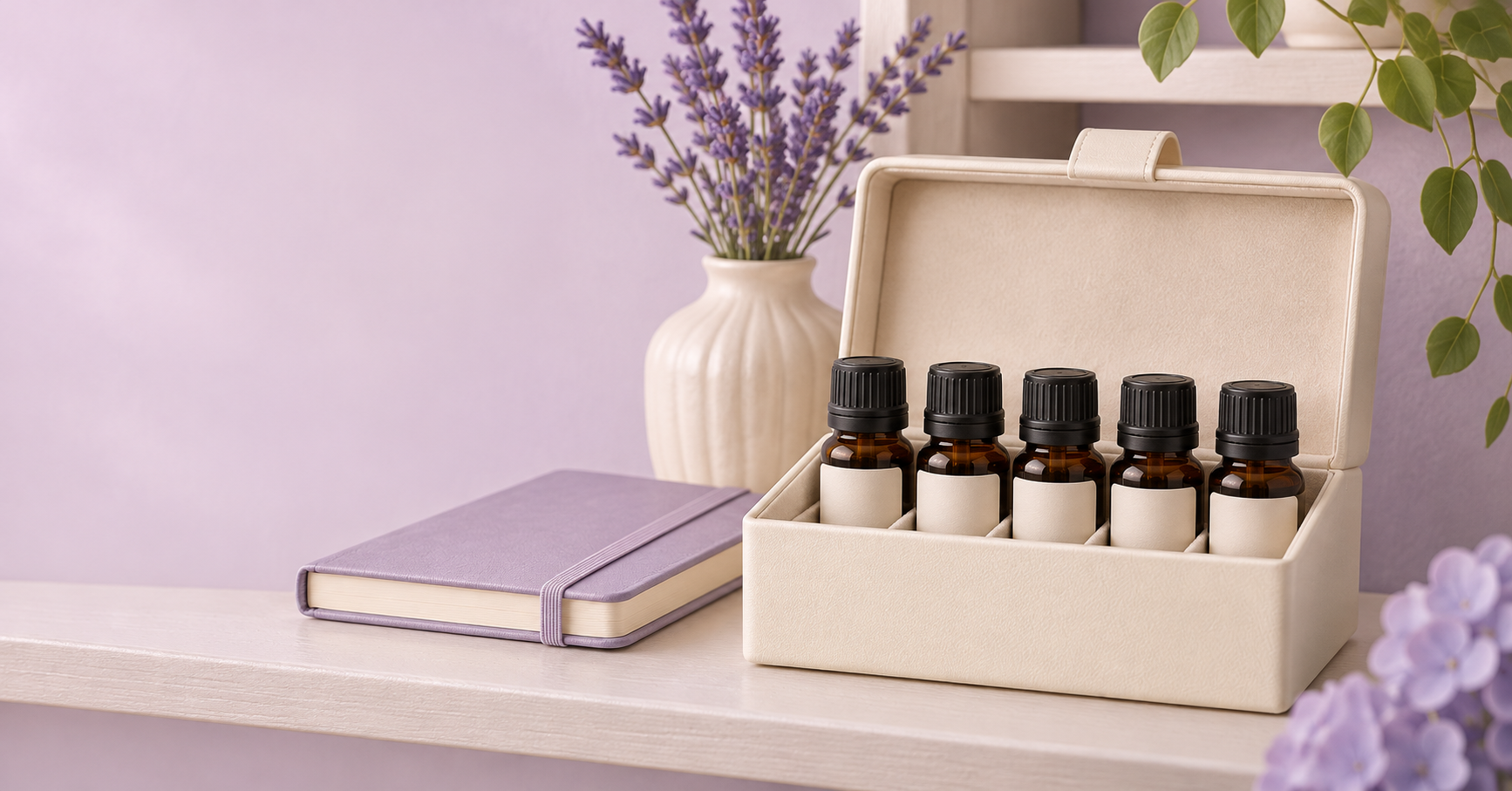
After opening an essential oil, keep its full name, batch code and first-opening date together. Then check the storage instructions and date information for that particular product. A single expiry date copied from a general list cannot account for every formulation, package and storage history.
What to check when you first open the bottle
Read the bottle and box while you have both to hand. Find the date information, any period-after-opening symbol and the storage instructions. Photograph the label with the batch code visible. Use the essential-oil label guide to work through the details.
Record the actual opening date in an ordinary note. If the manufacturer links part of the stated period to opening, the note gives you a starting point to check. It does not replace a date printed on the product or establish the condition of its contents.
The eoASSIST oil reference
Search for oils by name and open their reference entries.

Light, heat and an open cap
Tisserand Institute explains that increased exposure to heat, light and oxygen accelerates oxidative changes in essential oils. This gives you a reason to check where a bottle is kept and how it is closed. Use the packaging or the manufacturer to confirm the conditions for your product.
- Move the bottle away from direct sunlight.
- Check whether a heat source is nearby.
- Close the bottle after use rather than leaving its cap off for a long period.
- Keep the original packaging and label when they are needed to identify the product.
This article does not prescribe a refrigerator for every blend or finished product. The manufacturer's directions, ingredients and packaging matter for the particular bottle. Ask for clarification before changing its storage conditions if the instructions are unclear.
Why one stated period does not fit every bottle
Distinguish date information linked to production or expiry from a period counted after first opening. Products do not all present these details in the same way. For example, Tisserand Aromatherapy's FAQ explains period-after-opening labeling for its own products. That is the manufacturer's information, rather than a period for every brand.
The words "pure essential oil" and a familiar plant name do not reconstruct a bottle's history. They do not tell you when it was opened, how it was transported or whether the storage instructions were followed. Ask the seller or manufacturer for missing information if a bottle has no box or readable label.
A note template for one bottle
Copy this table into a notebook if it helps you keep the details together. It does not require a separate website tool.
| Field | What to record |
|---|---|
| Name | The full product and manufacturer names |
| Batch | The packaging code or a photograph of it |
| First opening | The actual date, if known |
| Date information | The exact wording on the package, without inventing missing dates |
| Storage | The conditions stated by the manufacturer |
| Questions | Missing information and the supplier contact |
When the storage history is unknown
If you do not know the opening date, record it as unknown. Do not silently substitute the purchase date. Ask the manufacturer what to do if the package is damaged, its date is unreadable or its contents have noticeably changed. A smell check alone does not establish that a product remains fit for use.
Use the eoASSIST catalogue to explore an oil's name. For your particular bottle's dates, use its packaging and the manufacturer's information. Keep your own opening dates in a separate note.
Sources
- Tisserand Institute on storage conditions. Used for the role of light, temperature and oxygen, without a universal shelf-life table.
- Tisserand Aromatherapy's manufacturer FAQ, the question about storage after opening. Checked on 11 November 2026. Its product directions are not transferred to other manufacturers.
The eoASSIST oil reference
Search for oils by name and open their reference entries.